Every now and then a project sneaks up on you.
You think you’re heading in one direction, and before you know it you’re somewhere completely different. That’s exactly what happened here.
I didn’t wake up one morning and decide to write an astrology book. If you’d asked me a year ago whether I’d ever spend months researching the zodiac, symbolism, mythology and centuries of accumulated human thought, I’d probably have laughed.
Yet here we are.
What fascinated me wasn’t astrology itself. It was a much simpler question.
Why has humanity kept returning to these same twelve symbols for thousands of years?
Civilizations have risen and fallen. Empires have come and gone. Religions have appeared, divided, merged and disappeared. Through it all, the zodiac has simply… remained.
Whether you believe in astrology or dismiss it completely is almost beside the point.
The interesting question is why it refuses to disappear.
That curiosity sent me down a rabbit hole I hadn’t planned on exploring.
 Not a Book About Belief
Let’s get something out of the way early.
This isn’t a book that tells you the stars control your destiny.
It isn’t a collection of daily horoscopes.
It isn’t another “manifest your perfect future” guide wrapped in mystical language.
And it certainly isn’t an attempt to convert sceptics into believers.
If anything, I approached the whole subject with more questions than answers.
The deeper I dug, the more I realised that astrology is less interesting as a system of prediction than it is as a language.
A language built from patterns.
A language that generations of people have used to describe personality, change, conflict, growth, seasons and the strange habit we humans have of searching for meaning.
You don’t have to believe a language is magical before you can appreciate how beautifully it’s been constructed.
A Curious Discovery
Somewhere along the way, this project stopped feeling like a reference book.
Instead, another idea appeared.
What if none of this was presented as a textbook?
What if it was discovered instead?
That thought became The Field Journal of the Unseen Astrologer.
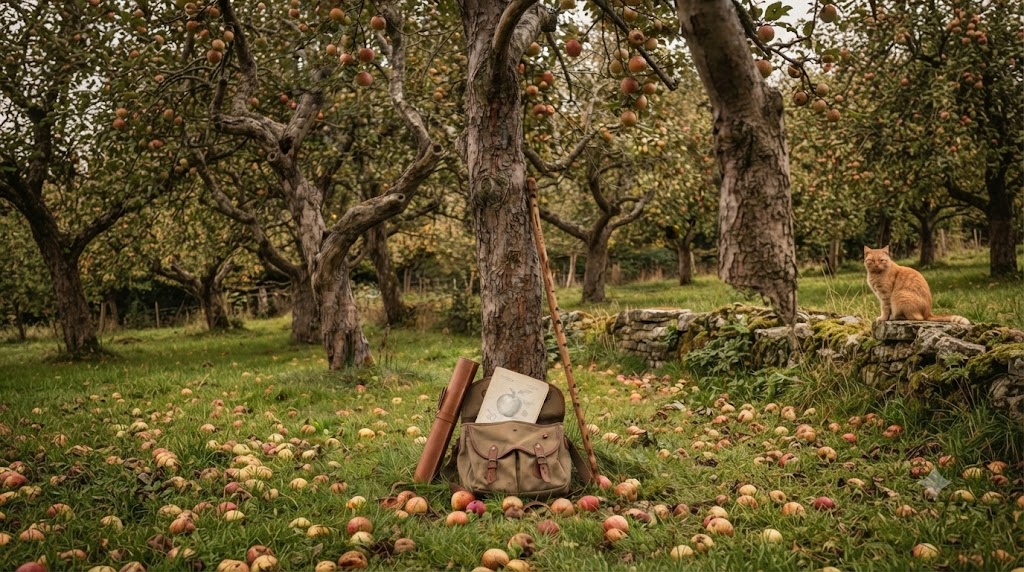
I imagined finding an old satchel beneath a weathered rowan tree. Inside were journals, sketches, hand-carved zodiac tiles, pressed flowers, notes scribbled in margins, little observations about birds, weather, trees and stars.
Not a prophet.
Not a guru.
Just someone who paid extraordinary attention to ordinary things.
The more I developed that idea, the more real this unseen traveller became.
Before long I found myself wondering what they’d notice on a spring morning… which path they’d take through the valley… why they’d stop beside one particular stream but ignore another.
That’s usually a good sign.
It means the story has started writing itself.
What Interested Me Most
One thing became obvious very quickly.
Most books about astrology seem to occupy one of two extremes.
One group confidently explains exactly how the universe works.
The other confidently explains why everyone else is wrong.
Neither approach interested me very much.
I found myself drawn to the space in between.
The place where curiosity lives.
The place where it’s perfectly acceptable to say, “That’s interesting… I wonder why people have believed this for so long?”
Whether astrology accurately predicts anything isn’t really the question this book asks.
Instead it asks whether these ancient symbols can still teach us something about observation, storytelling, personality and the way human beings make sense of the world.
I think that’s a far more interesting conversation.
Learning to Notice Again
Oddly enough, astrology wasn’t the biggest lesson I took away from writing this book.
Observation was.
The unseen astrologer notices everything.
The first blossom after winter.
The robin that returns to the same branch.
The way morning light changes across an old oak table.
A repaired tool that still carries the marks of its previous owner.
The smell of rain before the clouds arrive.
These things don’t predict the future.
But they remind us that paying attention is a skill.
And perhaps one we’ve become rather good at forgetting.
So… Is This Really an Astrology Book?
Yes.
And no.
The zodiac provides the framework.
But the real subject is curiosity.
It’s about looking more carefully.
Asking better questions.
Following interesting trails simply because they’re interesting.
If, by the final page, you’ve learnt a little about astrology, that’s wonderful.
If you’ve learnt to notice your own world a little more closely, I’d consider that an even better outcome.
Who Will Enjoy This?
If you’re looking for someone to tell you exactly what next Tuesday has in store, this probably isn’t your book.
If you’ve already decided astrology is absolute nonsense and refuse to entertain the possibility that ancient ideas might still contain useful observations, it probably isn’t your book either.
But…
If you’re curious.
If you enjoy beautiful books.
If you like wandering down unexpected rabbit holes.
If you appreciate craftsmanship, symbolism, history and quiet observation…
…then I think you’ll feel quite at home here.
One Final Thought
Writing this book reminded me of something I’d almost forgotten.
The world isn’t short of wonders.
We’re just remarkably good at walking straight past them.
Perhaps that’s why the zodiac has survived for so long.
Not because it answers every question.
Because it encourages us to keep asking them.
If that sounds like your sort of journey, I’d love you to come along.
Not everything that survives for thousands of years is true. But everything that survives for thousands of years is worth understanding